Home / Case Studies / Virtual Factory Operations Cockpit

Industrial Digital TwinBack to Portfolio

Virtual Factory Operations Cockpit

Client/Sector: Simam Digital / manufacturing POC

A browser-based factory digital twin combining live operational context, 3D HMI and decision support.

Project Snapshot

  • FocusFactory visibility, maintenance context and operational alerts
  • Platformrealvirtual WEB, browser 3D and industrial interface design
  • OutcomeA tangible manufacturing POC accessible through a single link.
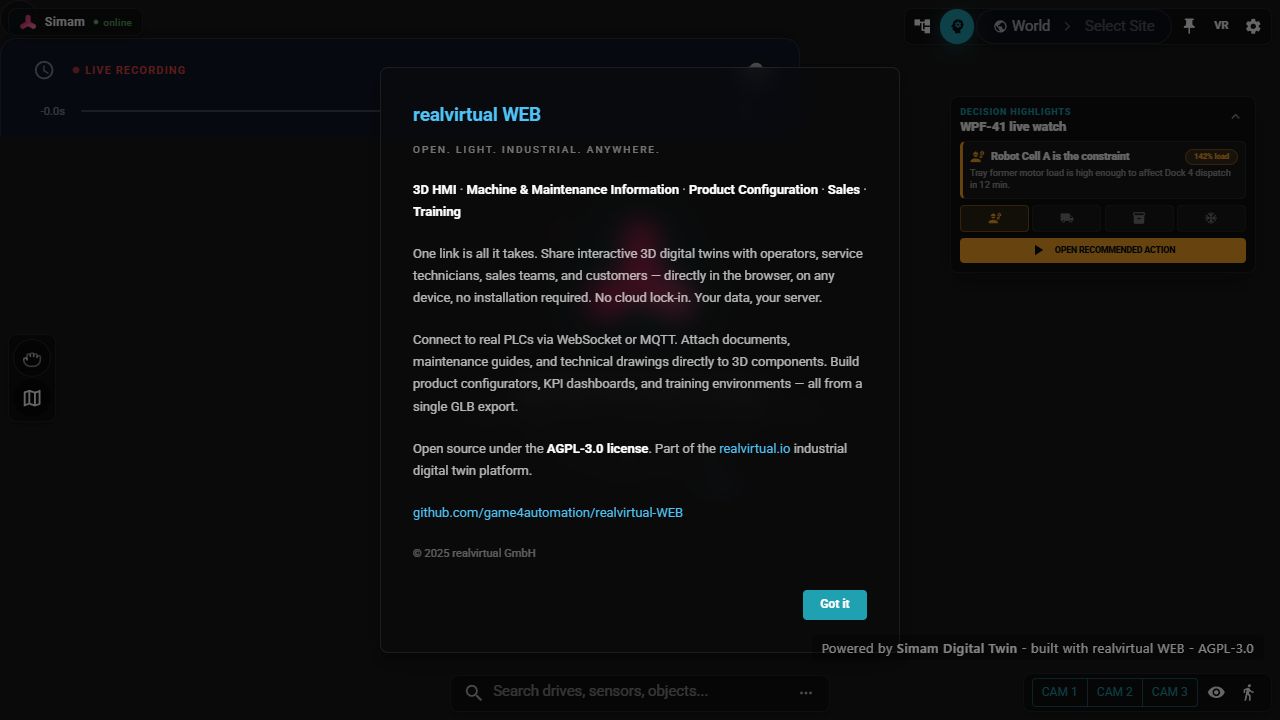
Virtual Factory Operations Cockpit live product screenshot

01 Challenge

The product problem

Industrial teams need to understand bottlenecks, maintenance risk and downstream impact without requiring every stakeholder to install specialist engineering software. The experience had to be useful to operators and legible to decision-makers.

02 Approach

Turning complexity into a usable product

I developed the Wakefield Operations Cockpit around decision highlights and contextual 3D. The interface surfaces the constrained robot cell, equipment load and likely dispatch impact, connecting technical status to an operational consequence.

03 Execution

What I designed and built

The self-hosted showcase uses realvirtual WEB as its open foundation and layers Simam Digital product thinking around hierarchy, annotations, VR/AR access and an operations copilot. Attribution to the underlying AGPL project is retained visibly.

04 Outcome

What the POC proves

The POC demonstrates a pragmatic route from industrial 3D data to a shareable web product. It showcases digital-twin integration, operations UX and the ability to build on open technology responsibly.
Technical delivery

How the product was shaped

The factory cockpit combines a 3D HMI with operational signals. The engineering value lies in maintaining one asset and state model across the spatial scene, KPIs, alarms and investigation workflow.

One identity from machine to dashboard

Each line or machine required a stable identifier shared by the 3D scene, telemetry and interface. Selecting an object could then drive the same detail and history as selecting an alarm or table row, avoiding the common digital-twin failure where the model and dashboard behave as separate demonstrations.

Alarms as workflow, not colour

Severity, acknowledgement, ownership and time were represented separately so an issue had an operational lifecycle. Colour supported recognition but did not carry meaning alone. The interface connected an alarm to spatial location, affected asset and supporting signal before asking a user to decide what happened next.

3D used selectively

The spatial view was valuable for orientation and equipment relationships; charts and structured panels remained better for comparison and history. The cockpit deliberately combines both modes, demonstrating product judgement about when 3D improves an industrial workflow rather than treating visual novelty as the outcome.

Project summary

Virtual Factory Operations Cockpit quick facts

What was built
A browser-based factory digital twin combining live operational context, 3D HMI and decision support.
Role
Digital-twin product architecture, 3D HMI interaction, telemetry-state design and browser POC delivery.
Outcome
An NDA-safe POC demonstrating how a spatial factory view can support—not replace—structured operational decision making.
Stack
Browser 3D, factory asset hierarchy, simulated telemetry, alarm state, KPI components, scene selection and operations UX.

Frequently asked questions

Is this a disclosed client deployment?

No. It is presented as a self-hosted Simam Digital product or NDA-safe proof of concept without identifying confidential clients.