01 Challenge
The product problem
Gaussian-splat tools are powerful, but client delivery often stops at an editor or an unbranded viewer link. The opportunity was to organise captures and turn them into presentable, trackable spatial pages.
Client/Sector: Simam Digital / spatial-media product POC
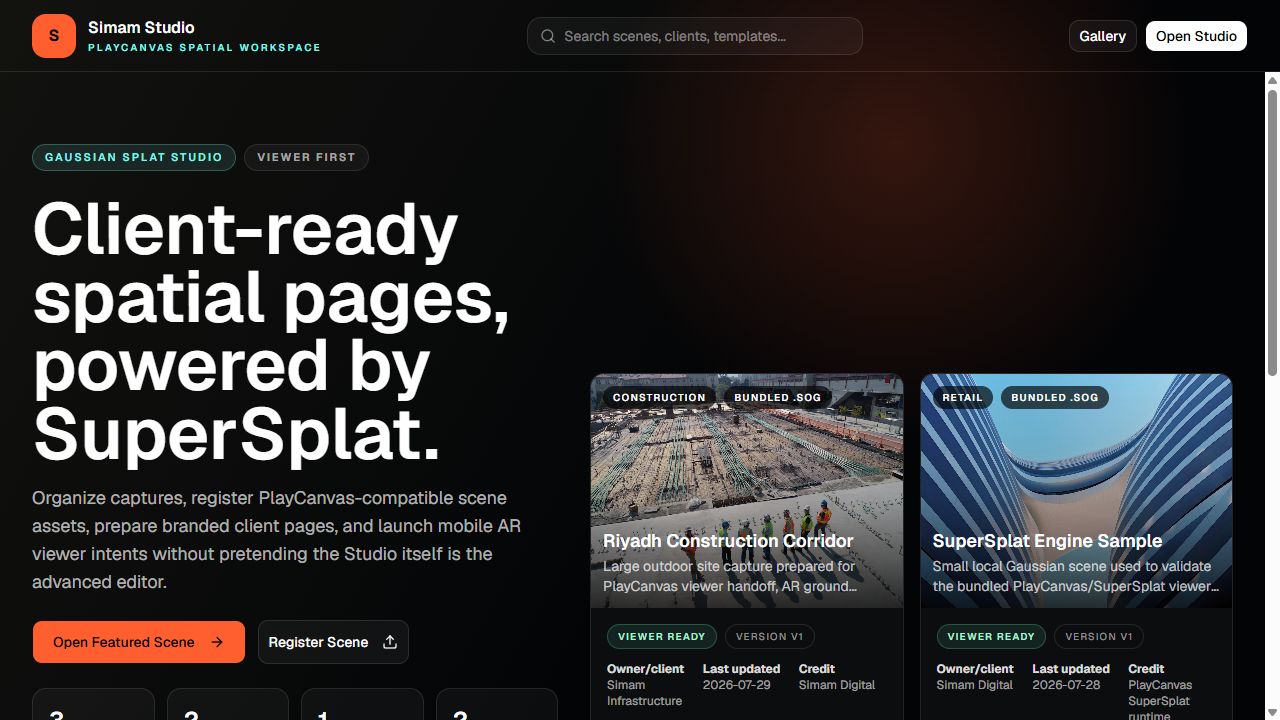
A client-ready workspace for organising Gaussian-splat captures and launching branded spatial viewers.
Project Snapshot
01 Challenge
Gaussian-splat tools are powerful, but client delivery often stops at an editor or an unbranded viewer link. The opportunity was to organise captures and turn them into presentable, trackable spatial pages.
02 Approach
I designed the Studio as a viewer-first workspace rather than pretending to replace specialist editing software. Scenes can be registered, grouped and prepared for client-facing pages, with clear status for viewer readiness and AR launch capability.
03 Execution
The POC references SuperSplat and PlayCanvas-compatible scene assets honestly. A gallery, featured-scene flow and registration workflow show how a future service could manage construction, property or place-based captures across versions.
04 Outcome
Simam Spatial Studio demonstrates product judgement around an emerging technology: it adds workflow and presentation value around the technical viewer. The result is a focused, credible foundation for spatial-capture delivery.
Technical delivery
Spatial Studio turns Gaussian-splat captures into manageable client projects. The product problem extends from uploading and organising large capture data to presenting a branded, performant viewer.
Large spatial files require visible upload, processing and readiness states. The workspace model connected each asset to a client project, capture metadata and viewer configuration so users could understand what was ready to review and what still required processing or correction.
Gaussian splats trade geometric structure for dense visual data. Browser delivery therefore depends on file size, streaming strategy, camera defaults, quality controls and device capability. The viewer experience was treated as part of the asset pipeline rather than a final iframe attached after processing.
Project settings separated client identity, scene presentation and navigation from the underlying capture. That creates a repeatable path from technical data to a shareable stakeholder experience and supports future permissions, revisions and embeds without rebuilding a custom viewer for each capture.
Project summary
No. It is presented as a self-hosted Simam Digital product or NDA-safe proof of concept without identifying confidential clients.