Home / Case Studies / Rehoboam Tactical AI Interface

Experimental InterfaceBack to Portfolio

Rehoboam Tactical AI Interface

Client/Sector: Simam Digital / fictional product experiment

A cinematic browser interface exploring global intelligence visualisation and high-density command UX.

Project Snapshot

  • FocusNarrative UI, data density and interactive world systems
  • PlatformBrowser application, mapping and real-time interface motion
  • OutcomeA memorable experimental interface demonstrating frontend range.
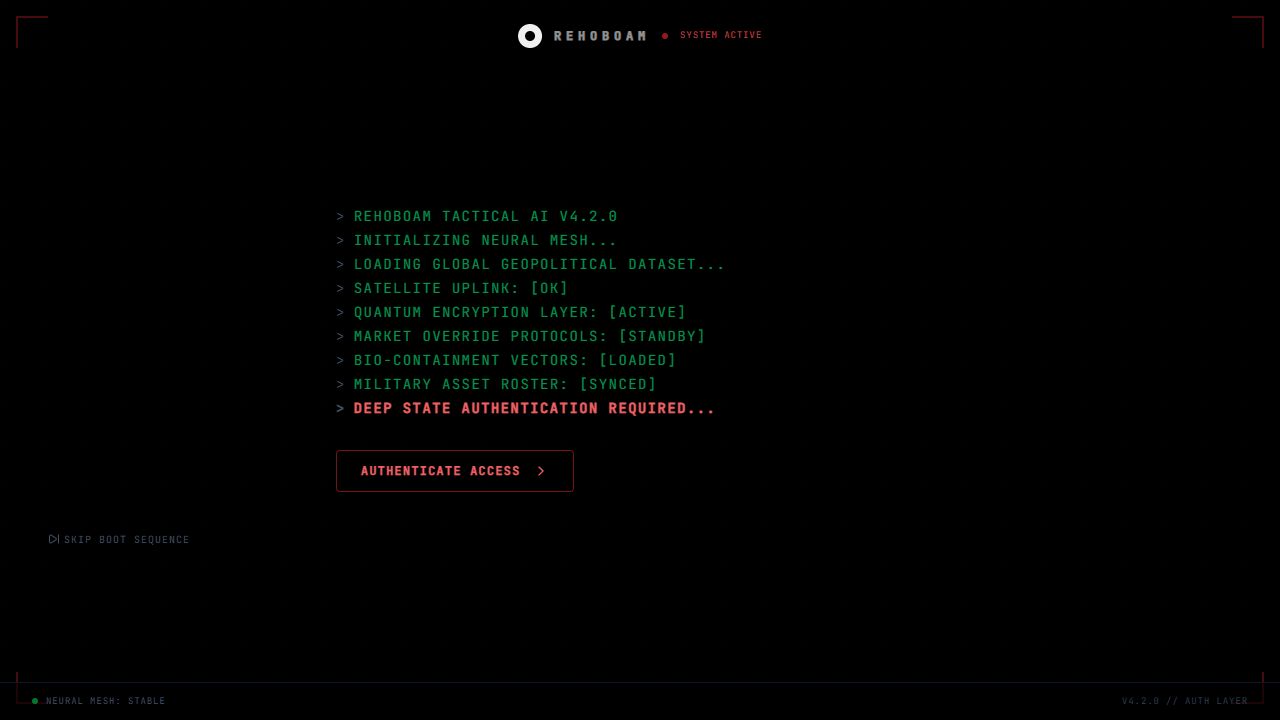
Rehoboam Tactical AI Interface live product screenshot

01 Challenge

The product problem

High-density operational interfaces often become unreadable or visually flat. This experiment asked whether a large amount of simulated geopolitical, aviation and asset data could feel legible while retaining a strong fictional command-centre identity.

02 Approach

Turning complexity into a usable product

I treated the product as an interface-design study inspired by cinematic tactical systems. Information is grouped into surveillance modes, regional assets and event feeds, with deliberate typography, system states and motion building the narrative.

03 Execution

What I designed and built

The browser experience includes a staged boot sequence, interactive world context, category controls and dense status displays. It is explicitly a fictional experimental product—not a live intelligence platform or commissioned client system.

04 Outcome

What the POC proves

The finished POC demonstrates range in data-heavy frontend engineering, motion design and world-building. It belongs in the portfolio as an experimental interface, clearly separated from operational client work.
Technical delivery

How the product was shaped

Rehoboam is a cinematic command-interface experiment focused on information density: how global signals, entities and emerging risks might be explored without reducing the experience to a conventional dashboard.

Hierarchy for high-density information

The interface uses location, severity, confidence and recency to decide what should dominate. Global context remains visible while a selected entity opens a deeper investigative path. That hierarchy prevents animation and cinematic styling from obscuring the questions an operator is trying to answer.

Entities, events and relationships

A useful intelligence interface needs distinguishable objects: people or assets, observations, places and relationships. Structuring the prototype around those concepts made filters and detail views consistent and created a credible foundation for graph, timeline or source-provenance features without pretending the demonstration contains live intelligence.

Motion used to preserve context

Transitions communicate movement between global and local scope, selection and state change. They are deliberately tied to navigation rather than decorative loops, with responsive fallbacks for smaller screens. The work demonstrates how a strong visual language can remain subordinate to information architecture.

Project summary

Rehoboam Tactical AI Interface quick facts

What was built
A cinematic browser interface exploring global intelligence visualisation and high-density command UX.
Role
Concept direction, command-UX architecture, interactive data visualisation and browser prototype delivery.
Outcome
A self-hosted interface experiment demonstrating strong visual systems thinking for intelligence, operations and command-style products.
Stack
Browser frontend, layered map visualisation, entity and event models, filtering, animated transitions and responsive high-density UI.

Frequently asked questions

Is this a disclosed client deployment?

No. It is presented as a self-hosted Simam Digital product or NDA-safe proof of concept without identifying confidential clients.